Sensing AI for Real-World Physical Systems
Machine Learning for Optical Fiber Sensing over Deployed Telecommunication Infrastructure
Overview
Telecommunication fiber networks provide a large-scale sensing substrate that extends beneath cities and along long-haul routes. Distributed fiber sensing turns existing optical cables into sensors for the physical world, while modern machine learning makes it possible to extract useful information from the resulting large-scale spatiotemporal data.
Networks
Sensing
at Scale
Learning
Intelligence
My research develops machine learning methods for distributed acoustic and temperature sensing, with an emphasis on turning raw sensing signals into reliable physical-world intelligence. Applications include infrastructure monitoring, cable protection, traffic and vehicle sensing, manhole localization and condition diagnostics, and other forms of situational awareness over deployed telecommunication networks.
The work spans learning from limited supervision, generalization and adaptation across sensing environments, probabilistic and generative modeling, foundation-model adaptation, and structured prediction. A central goal is to connect advances in machine learning with sensing systems that operate beyond controlled laboratory settings, using deployed infrastructure as both a source of real-world data and a testbed for generalization, adaptation, and validation.
Research Themes
Learning from Limited Supervision
Deployed fiber-optic sensing networks generate massive streams of spatiotemporal data, but obtaining precise task-specific annotations is often expensive and operationally difficult. My research explores how to turn this abundance of unlabeled and weakly labeled field data into an advantage, using weakly supervised learning, self-supervised learning, semi-supervised learning, and generative semi-supervised learning to learn useful sensing representations and build reliable models with limited manual labeling.
Generalization Across Sensing Environments
Models trained in one sensing environment or deployment configuration may not transfer reliably to another. My research studies inductive biases, representation learning, and adaptation mechanisms that improve generalization across sensing environments, routes, and configurations, with field deployments providing realistic tests of robustness.
Adaptation and Multimodal Foundation Models
Pretrained audio and multimodal models provide transferable knowledge for downstream sensing domains, but substantial domain shifts can arise when adapting them to fiber-optic sensing data. My recent work explores support-set adaptation, knowledge distillation, and noise-aware representation learning to efficiently transfer this knowledge to domain-specific sensing tasks.
Structured Prediction for Linear Infrastructure
Many critical infrastructure systems—including roads, highways, railways, pipelines, power lines, and telecommunication networks—extend over long linear corridors, making distributed fiber sensing a natural platform for large-scale monitoring. My research explores structured prediction along these corridors, using dense spatial information from distributed sensing together with geospatial context to continuously localize events and monitor infrastructure conditions in the physical world.
Research Progression
Representative work progresses from weakly supervised landmark localization using ambient noise (Optics Express 2023), to energy-based generative classification that leverages unlabeled DAS data through semi-supervised modeling while supporting uncertainty calibration (ECOC 2025 Top-Scored Paper), to self-supervised representation learning and adaptation that uses sensing location as a pseudo-label to learn transferable representations across deployed fiber routes (JOCN 2026).
The research also progresses from event-level recognition (JLT 2024) to structured prediction for status monitoring over linear infrastructure (JLT 2026; OFC 2025 Top-Scored Paper), leveraging spatial and temporal context for fine-grained localization and infrastructure condition monitoring. Across these efforts, methods are developed and validated through field experiments on existing telecommunication fiber networks.
Field Deployment & Real-World Validation
Field deployment has been an integral part of my sensing research, using existing telecommunication networks to develop and validate sensing-AI methods under real-world operational conditions.
Cable Protection & Event Monitoring
Long-term abnormal-activity monitoring and threat assessment over deployed telecommunication fiber.
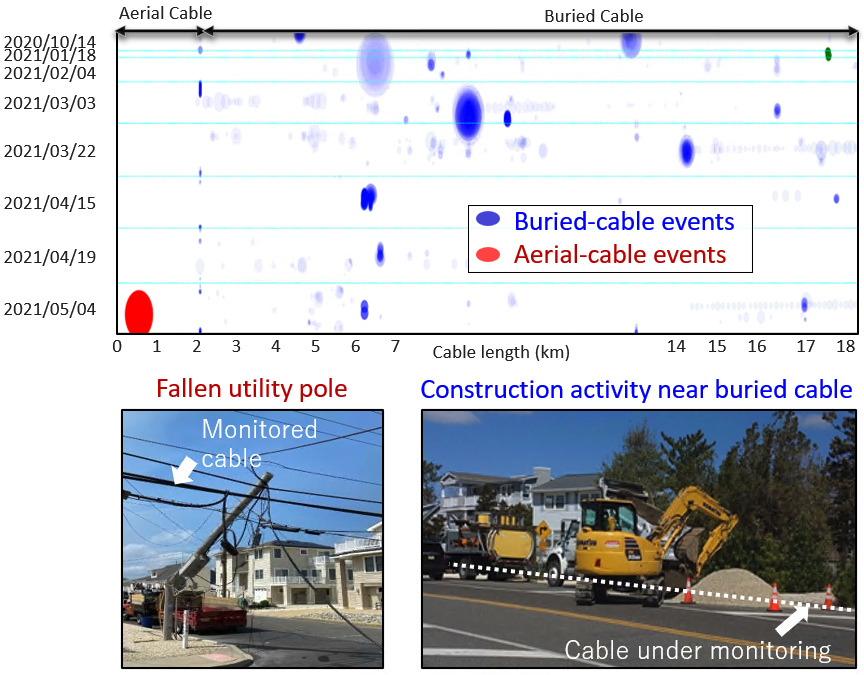
Representative field events include a fallen utility pole affecting aerial cable and construction activity near buried cable.
Infrastructure Localization & Diagnostics
Distributed acoustic and temperature sensing for infrastructure localization and condition assessment across deployed fiber routes.
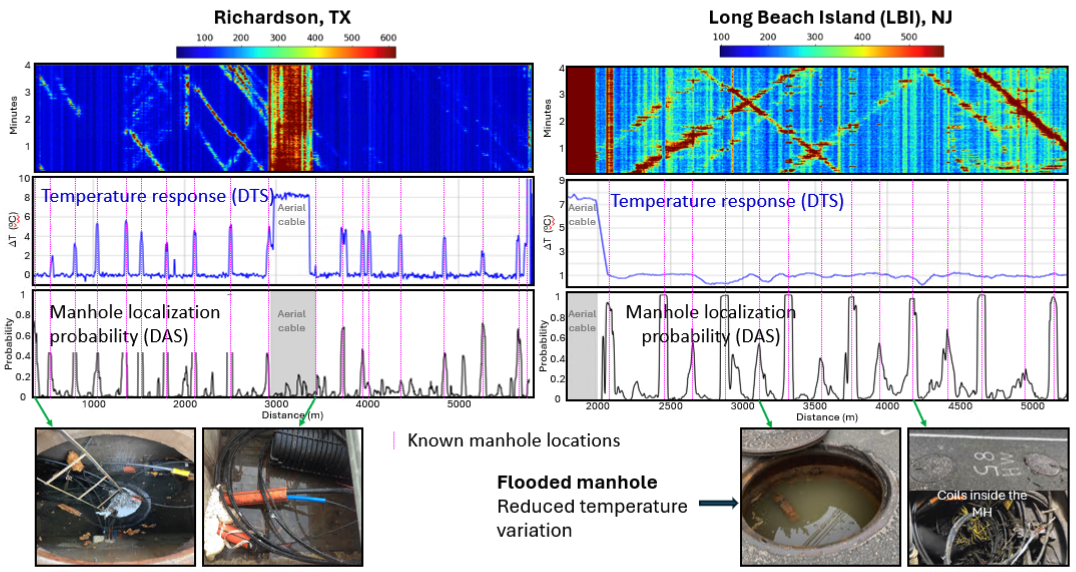
Field trials in Richardson, TX, and Long Beach Island, NJ, demonstrate complementary DAS and DTS information for manhole localization and condition diagnostics.
City-Scale Multimodal Sensing
Long-term fiber sensing integrated with satellite imagery and AI for live telecommunication infrastructure management.
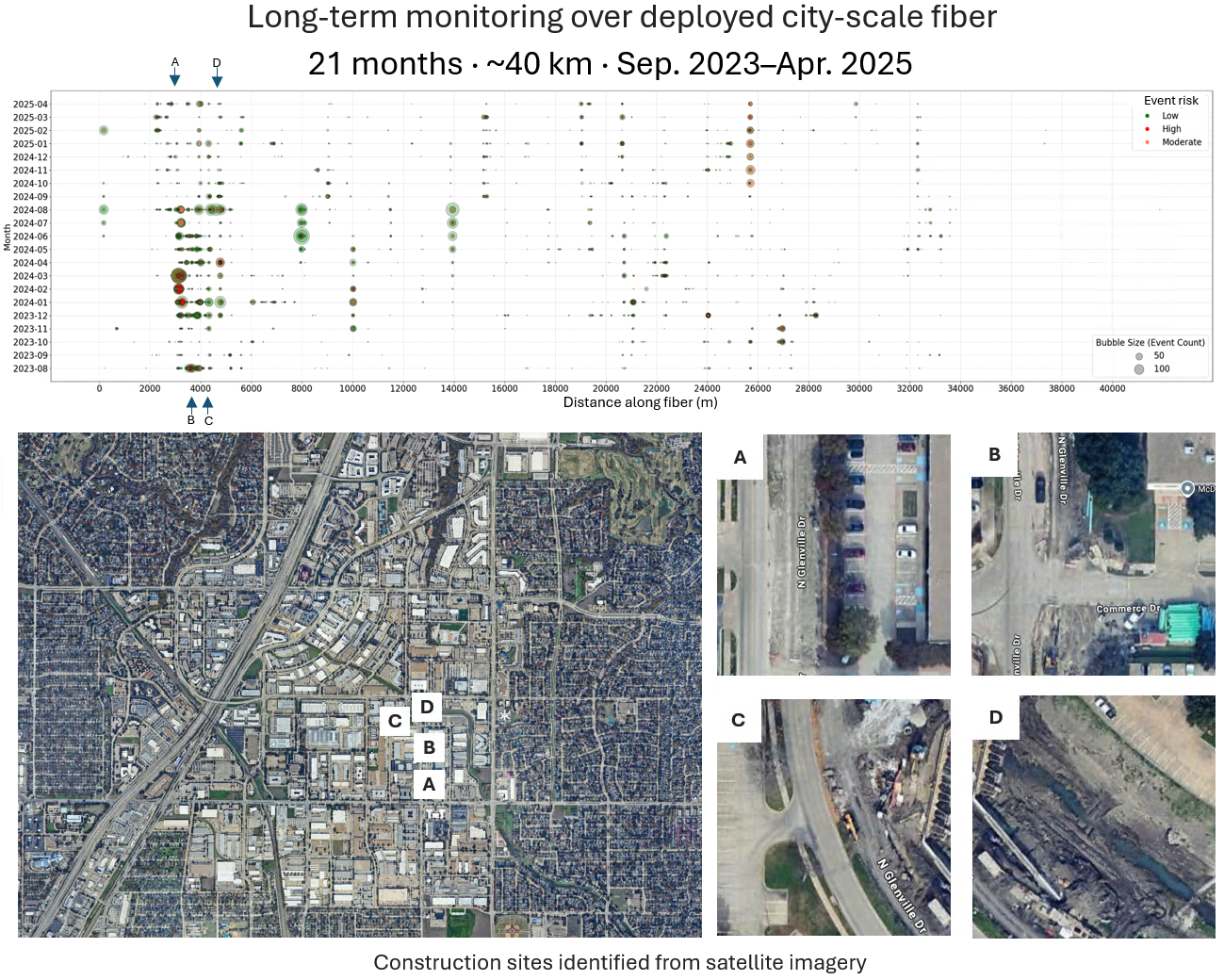
A 21-month field deployment over approximately 40 km of fiber, with construction activity cross-referenced using satellite imagery.
Datasets & Code
Public resources associated with this research include:
- CLAP-S — code for support-set adaptation of pretrained audio-language models. Code
- Gunshot–Firework Dataset — fiber-optic acoustic sensing dataset for downstream recognition. Dataset
Patents & Technology Transfer
Sensing-AI research has contributed to patented technologies spanning the full pipeline from machine-learning methodology to physical-world applications and operational systems:
ML Methodology for Fiber Sensing — methods spanning context encoders, self-supervised, contrastive, and weakly supervised learning; zero-shot domain adaptation and support-set adaptation of foundation models; generative and synthetic-data modeling; and memory-augmented learning for privacy-preserving system design.
Physical Infrastructure Sensing & Understanding — methods for localization, identification, and condition monitoring of buried and aerial cables, manholes and handholes, utility poles and fiber coils, roads and highways, vehicles and construction equipment, and other physical assets and landmarks along deployed fiber networks.
Real-World Sensing Applications — applications spanning cable protection and intrusion detection, traffic and vehicle sensing, infrastructure health monitoring, earthquake and acoustic-source localization, fiber-route mapping and geolocation, and public-safety use cases such as gunshot detection.
Systems, Prototypes & Technology Transfer — research prototypes integrate fiber sensing, AI, and real-time processing into end-to-end systems for field validation and operational use. Related NEC Labs America research has also progressed into commercial systems: the NEC Fiber Optic Smart Sensing (FOSS) solution provides a modular AI-analytics platform over deployed fiber for applications including Fiber Cable Monitoring, Fiber Cable Identification, Fiber Cable Position Locator, and Pigtail Finder.
Tutorials & Talks
- Machine Learning for Optical Fiber Sensing: Generalization, Adaptation, and Real-World Deployment — Invited Tutorial, OFS30 2026, Raleigh, NC, USA
- Generative AI for Distributed Acoustic Sensing over Telecom Networks — Invited Workshop Talk & Panelist, OECC/PSC 2025, Sapporo, Japan
Research Highlights & Media
- Turning Every Telecom Cable into a City-Wide Sensor Network — NEC Labs research story on turning deployed telecom fiber into large-scale sensing networks through advanced fiber sensing and self-supervised AI.
- Mix-CLAP: Teaching Audio AI to Work in the Noisy Real World — NEC Labs research story on compact, noise-aware audio-language models for real-world sensing and edge deployment.
- AI/fiber-optic combo poised to improve telecommunications — Laser Focus World coverage of our fiber-sensing AI research: Top Stories · Photonics Hot List
Fiber Sensing Publications
2026
Wataru Kohno, Shaobo Han, Noriyuki Tonami, Tingfeng Li, Jingchen Sun, and Ting Wang. “Mix-CLAP: Adaptive Fusion of Knowledge-distilled Audio Embeddings for Noise-Aware Audio-Language Models.” IEEE International Conference on Acoustics, Speech and Signal Processing (ICASSP 2026), Barcelona, Spain, 2026.
Shaobo Han, Ming-Fang Huang, Yue-Kai Huang, and Philip N. Ji. “Rapid State-of-Polarization Change Point Detection via Minimum Lossy Coding Length.” OECC 2026. Oral.
Scott Kotrla, Ming-Fang Huang, Jian Fang, Shaobo Han, Jamie Lynn, Ezra Ip, Jeffrey A. Mundt, and Ting Wang. “Leveraging Deployed Telecom Cables for Distributed Fiber Sensing Topologies and Applications.” Journal of Optical Communications and Networking, Vol. 18, No. 4, pp. B72–B84, 2026.
Shaobo Han, Ming-Fang Huang, Yaowen Li, Glenn A. Wellbrock, Tiejun J. Xia, Scott Kotrla, Jeffrey A. Mundt, James M. Moore, Philip Ji, Tingfeng Li, Yuheng Chen, Ting Wang, and Yoshiaki Aono. “Manhole Localization and Condition Diagnostics in Telecom Networks Using Distributed Acoustic and Temperature Sensing.” IEEE Journal of Lightwave Technology, Vol. 44, No. 3, pp. 1086–1093, 2026.
2025
Jingchen Sun, Shaobo Han, Wataru Kohno, and Changyou Chen. “CLAP-S: Support Set-Based Adaptation for Fiber-Optic Acoustic Recognition.” IEEE International Conference on Acoustics, Speech and Signal Processing (ICASSP 2025), Hyderabad, India, 2025. Lecture.
Wataru Kohno, Noriyuki Tonami, Jian Fang, Shaobo Han, Jingchen Sun, and Ting Wang. “Text-guided Device-Realistic Sound Generation for Fiber-based Sound Event Classification.” IEEE International Conference on Acoustics, Speech and Signal Processing (ICASSP 2025), Hyderabad, India, 2025.
Shaobo Han, Ming-Fang Huang, Tingfeng Li, Scott Kotrla, Jeffrey A. Mundt, Ting Wang, and Yoshiaki Aono. “Energy-based Generative Models for Distributed Acoustic Sensing Event Classification in Telecom Networks.” ECOC 2025. Top-Scored Paper.
Ming-Fang Huang, Tingfeng Li, Shaobo Han, Biplob Debnath, Eric Cosatto, Tina Zheng, Scott Kotrla, Glenn A. Wellbrock, Tiejun J. Xia, Jeffrey A. Mundt, Ting Wang, Yoshiaki Aono, and Koji Asahi. “First City-Scale Deployment of DASs with Satellite Imagery and AI for Live Telecom Infrastructure Management.” OECC 2025, PDP-A-4. Postdeadline Paper.
Fatih Yaman, Andrea D’Amico, Shaobo Han, Shinsuke Fujisawa, Eduardo Mateo, and Takanori Inoue. “Span-based Polarization Sensing in Cables Without Reflectors.” OECC 2025, WC3-3. Oral.
Shaobo Han, Philip N. Ji, and Ting Wang. “Dual Privacy Protection for Distributed Fiber Sensing with Disaggregated Inference and Fine-tuning of Memory-Augmented Networks.” OFC 2025, W1D. Oral.
Ming-Fang Huang, Shaobo Han, Yaowen Li, Glenn A. Wellbrock, Tiejun J. Xia, Scott Kotrla, James M. Moore, Philip Ji, Tingfeng Li, Yuheng Chen, Ting Wang, and Yoshiaki Aono. “Field Trials of Manhole Localization and Condition Diagnostics by Using Ambient Noise and Temperature Data with AI in a Real-Time Integrated Fiber Sensing System.” OFC 2025, M1C. Top-Scored Paper.
Tingfeng Li, Ming-Fang Huang, Shaobo Han, Yaowen Li, Glenn A. Wellbrock, Tiejun J. Xia, Scott Kotrla, James M. Moore, and Ting Wang. “Field Tests of AI-Driven Road Deformation Detection Leveraging Ambient Noise over Deployed Fiber Networks.” OFC 2025, M1C. Oral.
2024
Shaobo Han, Ming-Fang Huang, Tingfeng Li, Jian Fang, Zhuocheng Jiang, and Ting Wang. “Deep Learning-based Intrusion Detection and Impulsive Event Classification for Distributed Acoustic Sensing across Telecom Networks.” IEEE Journal of Lightwave Technology, Vol. 42, No. 12, 2024.
Zhuocheng Jiang, Yangmin Ding, Junhui Zhao, Yue Tian, Shaobo Han, Sarper Ozharar, Ting Wang, and James M. Moore. “Seeing the Vibration from Fiber-Optic Cables: Rain Intensity Monitoring using Deep Frequency Filtering.” 20th IEEE Workshop on Perception Beyond the Visible Spectrum (PBVS), 2024.
2023
Glenn A. Wellbrock, Tiejun J. Xia, Ming-Fang Huang, Shaobo Han, Yuheng Chen, Ting Wang, and Yoshiaki Aono. “Explore Benefits of Distributed Fiber Optic Sensing for Optical Network Service Providers.” IEEE Journal of Lightwave Technology, Vol. 41, No. 12, 2023.
Alexander Bukharin, Shaobo Han, Yuheng Chen, Ming-Fang Huang, Yue-Kai Huang, Yao Xie, and Ting Wang. “Ambient Noise based Weakly Supervised Manhole Localization Methods over Deployed Fiber Networks.” Optics Express, Vol. 31, No. 6, pp. 9591–9607, 2023.
Fatih Yaman, Yang Li, Shaobo Han, Takanori Inoue, Eduardo Mateo, and Yoshihisa Inada. “Polarization Sensing using Polarization Rotation Matrix Eigenvalue Method.” OFC 2023, W1J.7. Oral.
2022
Ezra Ip, Fabien Ravet, Hugo Martins, Ming-Fang Huang, Tatsuya Okamoto, Shaobo Han, Chaitanya Narisetty, Jian Fang, Yue-Kai Huang, Milad Salemi, Etienne Rochat, Fabien Briffod, Alexandre Goy, Maria del Rosario Fernández-Ruiz, and Miguel González Herráez. “Using Global Existing Fiber Networks for Environmental Sensing.” Proceedings of the IEEE, 2022.
Ming-Fang Huang, Jian Fang, Shaobo Han, Zhuocheng Jiang, Sarper Ozharar, Yuheng Chen, Tomoyuki Hino, and Ting Wang. “Field Tests of Impulsive Acoustic Event Detection, Localization, and Classification over Telecom Fiber Networks.” OECC 2022, PDP-A-1. Postdeadline Paper.
Ting Wang, Ming-Fang Huang, Shaobo Han, and Chaitanya Narisetty. “Employing Fiber Sensing and On-premise AI Solutions for Cable Safety Protection over Telecom Infrastructure.” OFC 2022, Th3G.1.
2021
Ming-Fang Huang, Shaobo Han, Glenn A. Wellbrock, Tiejun J. Xia, Chaitanya Narisetty, Milad Salemi, Yuheng Chen, James M. Moore, Philip N. Ji, Giovanni Milione, Ting Wang, Yukihide Yoda, Yoshinori Kitahara, Morio Ito, Yoshiaki Aono, and Atsuo Itoh. “Field Trial of Cable Safety Protection and Road Traffic Monitoring over Operational 5G Transport Network with Fiber Sensing and On-Premise AI Technologies.” OECC 2021, T5A.8. Postdeadline Paper.
Tingfeng Li, Yuheng Chen, Ming-Fang Huang, Shaobo Han, and Ting Wang. “Vehicle Run-off-road Event Automatic Detection by Fiber Sensing Technology.” OFC 2021, Th1A.26.
You Lu, Yue Tian, Shaobo Han, Eric Cosatto, Sarper Ozharar, and Yangmin Ding. “Automatic Fine-grained Localization of Utility Pole Landmarks on Distributed Acoustic Sensing Traces based on Bilinear ResNets.” IEEE International Conference on Acoustics, Speech and Signal Processing (ICASSP 2021), Toronto, Ontario, Canada, 2021.
Tiejun J. Xia, Glenn A. Wellbrock, Ming-Fang Huang, Shaobo Han, Yuheng Chen, Milad Salemi, Philip N. Ji, Ting Wang, and Yoshiaki Aono. “Field Trial of Abnormal Activity Detection and Threat Level Assessment with Fiber Optic Sensing for Telecom Infrastructure Protection.” OFC 2021, Th4H.3. Oral. Tingye Li Innovation Prize Finalist.